
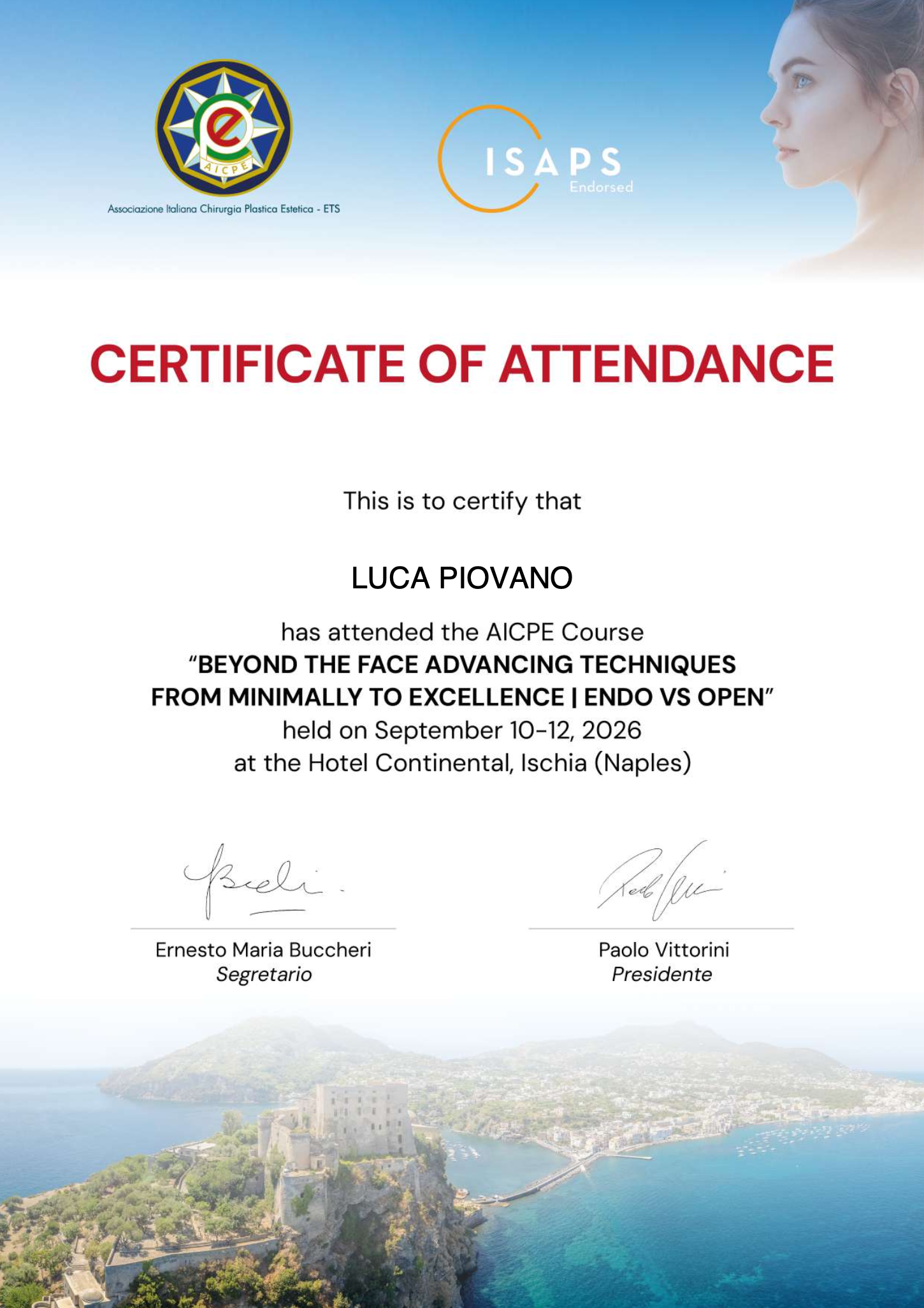
From 10 to 12 September 2026 I took part in Beyond the Face, the live surgery course organized by AICPE (Associazione Italiana di Chirurgia Plastica Estetica), of which I am a founding member. The second edition, endorsed by ISAPS, was held at the Hotel Continental in Ischia under the scientific direction of Pierluigi Canta and Franco Vercesi, and gathered an international faculty and international attendees around the surgery of the face and the peri-facial area.
The theme of the 2026 edition: endoscopic versus open
The programme was built around the title “Advancing Techniques from Minimally to Excellence: Endo vs Open”. Over three days the course combined anatomy sessions on both the open and the endoscopic approach, live surgery comparing open deep plane lifting, endoscopic deep plane lifting and neck contouring, and a final session on the “full face” approach, where fat transfer, thread lifting, laser treatments and aesthetic medicine are integrated with minimally invasive surgery.
My take from Ischia
In the short clip below, recorded at the congress, I sum up what I consider the real lesson of a course like this: the technique is never the point in itself.
“The course we are attending is an international course with an international faculty and international attendees, so it’s a major, very important course organized by Italians.
We talked about endoscopic lifting, traditional lifting and deep face lift. All techniques are good, but it’s about the right indication for the patient, for the correction we want to make.
The surgeon must have this varied repertoire of techniques.”
This is the same principle I apply in my practice in Rome: endoscopic, deep plane and traditional facelift are tools, and the indication for each patient decides which one to use. You can read how I approach facelift surgery (ritidoplastica) and, for the non-surgical options, the comparison between lifting, threads and laser.
Beyond the Face follows IMCAS China 2026 in Shanghai, where I was part of the faculty at the end of August: two international appointments in three weeks, on two very different stages, with the same aim of keeping the surgical repertoire up to date.